

Animal Welfare Children’s Book: Cultivating Kids’ Compassion For Other Animals
Loving all beings and contributing to their wellness is a fundamental dimension of agape ethics. Thus, as part of our Extending Concern focus, we are working on a beautifully illustrated children’s book about human-nonhuman relationships, animal welfare and activism.
Credit: Yuna Fauveau
What Is This Children's Book's Purpose?
Thanks to real life stories of people committed to improving animal rights, and true tales of friendships between humans and other animals, this book aims to nurture children’s compassion for all non-human animals. Not only might it help kids understand how similar to us other animals are, but it might also inspire them to take action, however small and simple, towards reducing animal harm.
Through this touching and educational illustrated book, we wish to strengthen children’s instinctive empathy for other animals. Furthermore, by encouraging them to act according to the love they feel, we hope to participate in making the world kinder and safer, both for non-humans and humans.
How Will This Illustrated Book Fulfil Its Mission?
We intend for this book to gather between 20 and 30 inspiring stories, with many of them understandable from 6 years old. Moreover, parents of younger kids are welcomed to read through the book with them.
In order for older children to enjoy it as well, the book will contain different reading levels, going from easiest at the beginning of the book to most difficult at the end. Additionally, words or concepts that are more specific and complex will get their own explanatory bubble.
Each story will be accompanied by an original illustration as well as a practical and fun activity such as:
-
baking simple and delicious vegan cupcakes;
-
creating a TED-like presentation;
-
visiting an animal sanctuary instead of a zoo;
-
designing an animal-loving Frankenstein creature;
-
and many more!
(Just know that some of these ideas are subject to change, since the book is still a work in progress.)
For the purposes of reaching as many children as possible with these stories’ messages, we are planning to publish this book. And as we would like to keep it accessible, we are hoping to use some kind of tiered pricing, while offering the chance to people to pay more to support us/other people's cheaper purchases.
This would allow us to support both persons with limited financial means and volunteers contributing to the book.
What Do the Animal Welfare Stories Look Like?
If you are curious about our book’s stories, you can have a look at two of them—paired with their illustration—right below.
Kenneth Damro

Credit: Barbora štýblová
Ken’s family loved hunting and fishing. As he grew up, those things meant everything to him. He made friends with other hunters, and they had fun talking about and going hunting together.
But Ken gradually began to realize something was wrong. At a baseball game, he saw an awful injury - a player’s ankle had broken off. He was struck by how similar it looked to the rabbits whose legs he’d broken off with a missed bullet.
At that point, he understood the separation he had thought was there between humans and animals didn’t really exist. Suffering is suffering, regardless of species.
Ken felt he should quit hunting, but he was scared. What if his friends and family no longer accepted him? He realized that it didn’t take courage to keep hunting - it took courage to quit, to risk his relationships.
The final straw was when he found a doe he had shot the day before. He saw that it must have suffered intense pain, and was even more deeply touched when he discovered the tracks of another doe, who must have had waited by her side until she had died. Following this, he quit hunting for good.
Telling his friends he wasn’t going to hunt with them anymore was hard, and he did lose some of them. But he felt much better about his new life than he ever did about going hunting.
Ken is now a vegan, working to help people make their buildings and land better for the wildlife and the environment, and has written a book titled ‘A Northwoodsman's Guide to Everyday Compassion’.
Dindim the Penguin
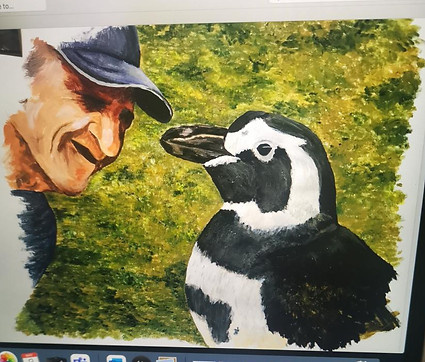
Credit: Claire
In Brazil, there was a man called João who lived in a house on the beach. One day, João came across a penguin lying on the sand. Man-made pollution, in the form of an oil spill, had led to the animal being covered in the sticky fuel. He could not move much, so João picked him up and carried him home. João named his new friend Dindim and, over the next few days, cleaned Dindim’s feathers and fed him to make him strong again. Soon it came time to say goodbye. Using a boat, João took Dindim to a nearby island and watched him swim away.
Later that same day, João heard a strange noise coming from outside. He went to investigate and saw Dindim standing in his garden! Dindim stayed with João and his wife for eight more months and became part of their family. A strong bond formed between the penguin and the man. Dindim would even let João pick him up and stroke his feathers. But one morning, Dindim swam out into the sea and did not return that day. João thought he’d never see his penguin friend again.
For the next four months, João and his wife lived alone. But then something amazing happened: Dindim came back! João was very happy to see his friend once more. Every year since then, Dindim has swum through the sea to spend several months with his human family.
Other Stories of the Book
We have several more stories ready, and others that still need to be written. To give you a better idea of the book’s content, here are some of their titles:
-
Jordi Casamitjana the Spy
-
Lulu the Pig
-
The Williams Sisters
-
Polo the Hero Dog
-
The Sea Lion at Golden Gate Bridge
-
Aaron Pitkin the Activist
-
Flipper’s Trainer
Please reach out to us if you are interested in working on the book with us—in particular, we are still looking for artists to illustrate these stories!